DNS Security
DNS Security Alert: One Domain, Three Different Answers
By Nattapong Sukkasem · Published · Updated .
TL;DR — At 09:00 Paris time on 24 November, the Swiss foundation Quad9 stopped answering queries from anyone its geolocation data places in France, after a Paris court attached a €1,000-a-day penalty to a blocking order sought by the broadcaster beIN. It did not withdraw its routes; it kept answering, with a refusal carrying Extended DNS Error code 18. The same day Google Public DNS still blocked 22 names from that list and Cloudflare blocked none. This DNS security story is about resolution becoming a question with more than one right answer.
The most consequential DNS security development of the week involves no attacker and nothing to patch. A recursive resolver serving much of Europe stopped serving one country, and how it stopped matters more than that it did.
Quad9 runs the public resolver at 9.9.9.9, plus 149.112.112.112 and the IPv6 addresses 2620:fe::fe and 2620:fe::9. It is a Swiss non-profit, and many networks treat it as a last-resort default. From Tuesday morning, for users in France, it answers nothing.

What actually happens to a query from France
Quad9 has not shut its French points of presence or withdrawn its anycast announcements. A packet sent to 9.9.9.9 from a French network still reaches a Quad9 server and still gets a reply. The reply is a refusal. Quad9 told TorrentFreak as much, and probes run in France after the cutoff came back carrying Extended DNS Error code 18, which RFC 8914 labels Prohibited, with a note citing the legal situation. The error text in TorrentFreak's screenshot reads “Service unavailable due to French legal constraints.”
The refusal is not selective. It is not the 118 domains on the beIN blocklist that stop resolving for French users; it is every name. Quad9's notice says any query reaching any Quad9 service address will be refused. The foundation also publishes an unfiltered service at 9.9.9.10, and no account says whether it is treated differently, a gap worth noting rather than guessing at.
The boundary is drawn by IP geolocation, applied per query against the source address, and Quad9 is blunt that its method is inexact. A French subscriber whose VPN exits in Helsinki keeps getting answers. A user in Nairobi whose traffic exits through a French datacentre does not.

The ruling, and a penalty that outlived its order
The underlying case is sports piracy. beIN, a Qatar-based broadcaster with French operations, obtained an order covering domains said to carry live sport it holds rights to. Quad9 declined to block, calling itself a neutral service that hosts nothing. On 21 October the Paris Judicial Court, in case RG 26/11882, attached a penalty of €1,000 a day; beIN had sought €580,000. Quad9 puts its exposure near €24,000 before legal costs and faces some twenty further cases in France. An appeal is pending; the withdrawal went ahead regardless.
One discrepancy is worth stating rather than smoothing over: TorrentFreak reports the order itself expired on 14 November with the WTA tennis season, while Quad9's post speaks of fines in the present tense. Nothing operational turns on it.
| Resolver | Behaviour for users in France | Blocked of 118 listed domains, 23 Nov | Basis |
|---|---|---|---|
| Quad9 (9.9.9.9, 149.112.112.112, 2620:fe::fe, 2620:fe::9) | All queries refused, EDE 18 Prohibited | Service withdrawn | Paris Judicial Court, 21 Oct, RG 26/11882 |
| Google Public DNS (8.8.8.8) | Answers, with per-name blocks | 22, down from 91 on 28 October | beIN notice, RG 26/02207, plus Arcom notices |
| Cloudflare (1.1.1.1) | Answers | 0 | French court rejected penalties over 1.1.1.1 |
| Cisco OpenDNS | Already withdrawn | Not measured | Left France and Portugal; Belgium temporarily |
| Orange resolvers | Still block at least one listed name | Not counted | ISP order; answers seen as 127.0.0.1 |
| DNS4EU (Whalebone) | Answers, with blocks applied EU-wide | Not measured | Applies country orders union-wide, per Cloudflare |
A refusal is the fastest answer a resolver can give
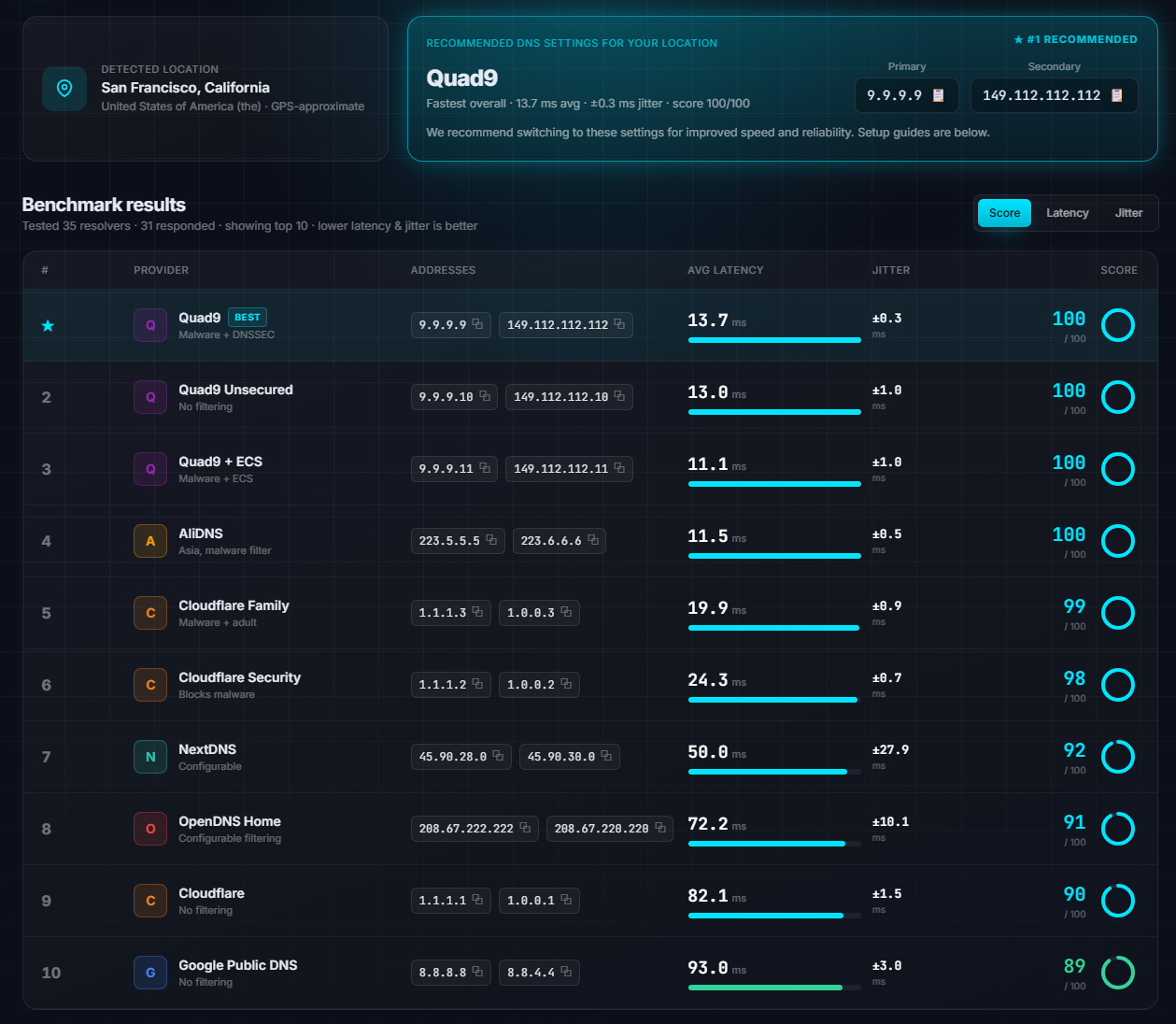
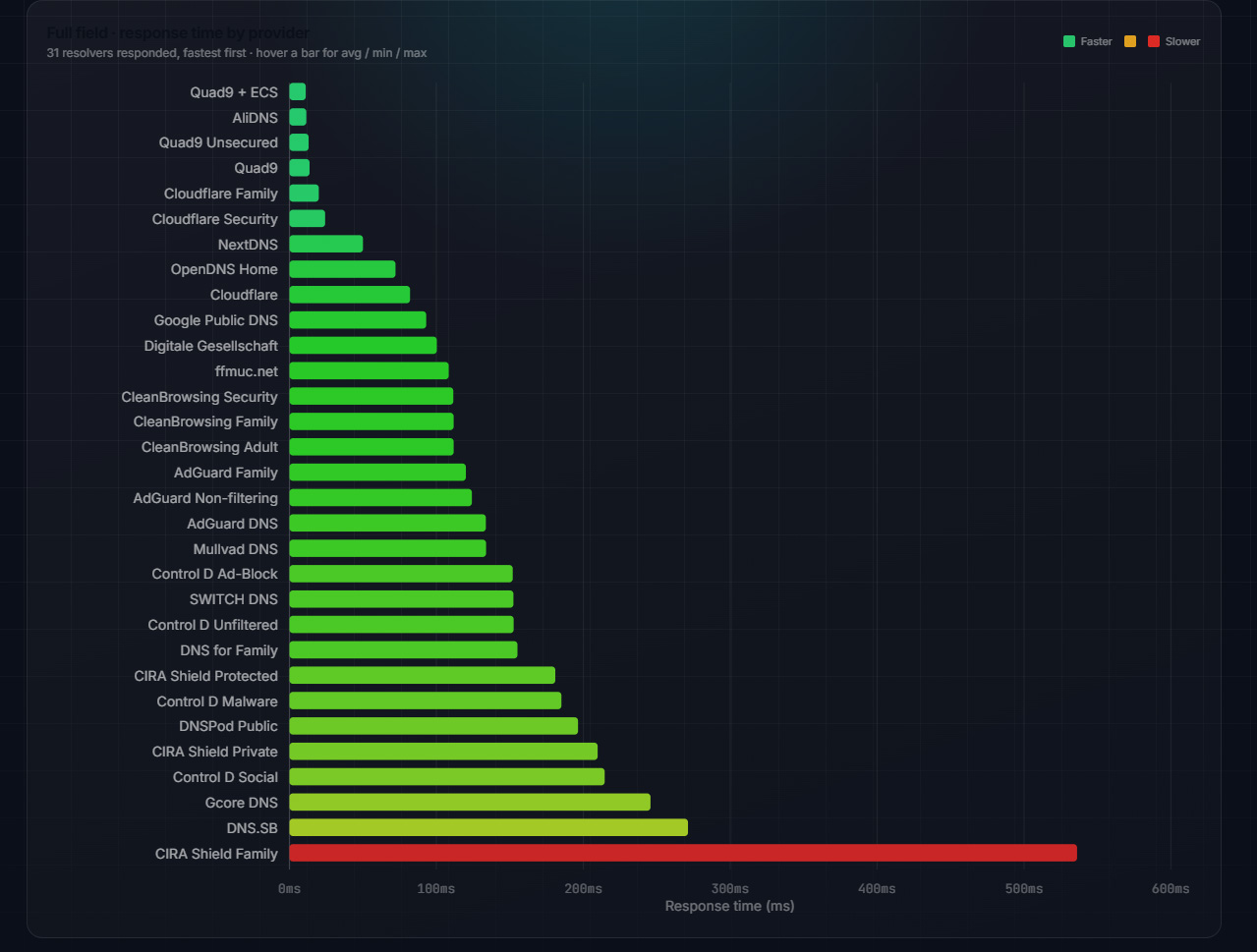
A refusal needs no recursion, no upstream query and no cache lookup. It is generated at the edge and returned at once. On a chart of DNS server performance, a resolver refusing everything from your network posts the best times you have ever recorded from it.
A check that measures round-trip time and treats any well-formed response as success shows a Quad9 endpoint in France as healthy, and improving, on the morning it stopped working. Network latency graphs look excellent; resolution is dead. Any check worth keeping asserts on the RCODE and now the Extended DNS Error code, not on how long the packet took.
The practical DNS security lesson is that this failure is silent where teams instrument most heavily, and loud only in logs nobody aggregates. Comparing what resolvers return for one name is now routine rather than a troubleshooting step: a network diagnostic tool such as our DNS lookup tool shows what a resolver answers today.
A geolocation database is not a border
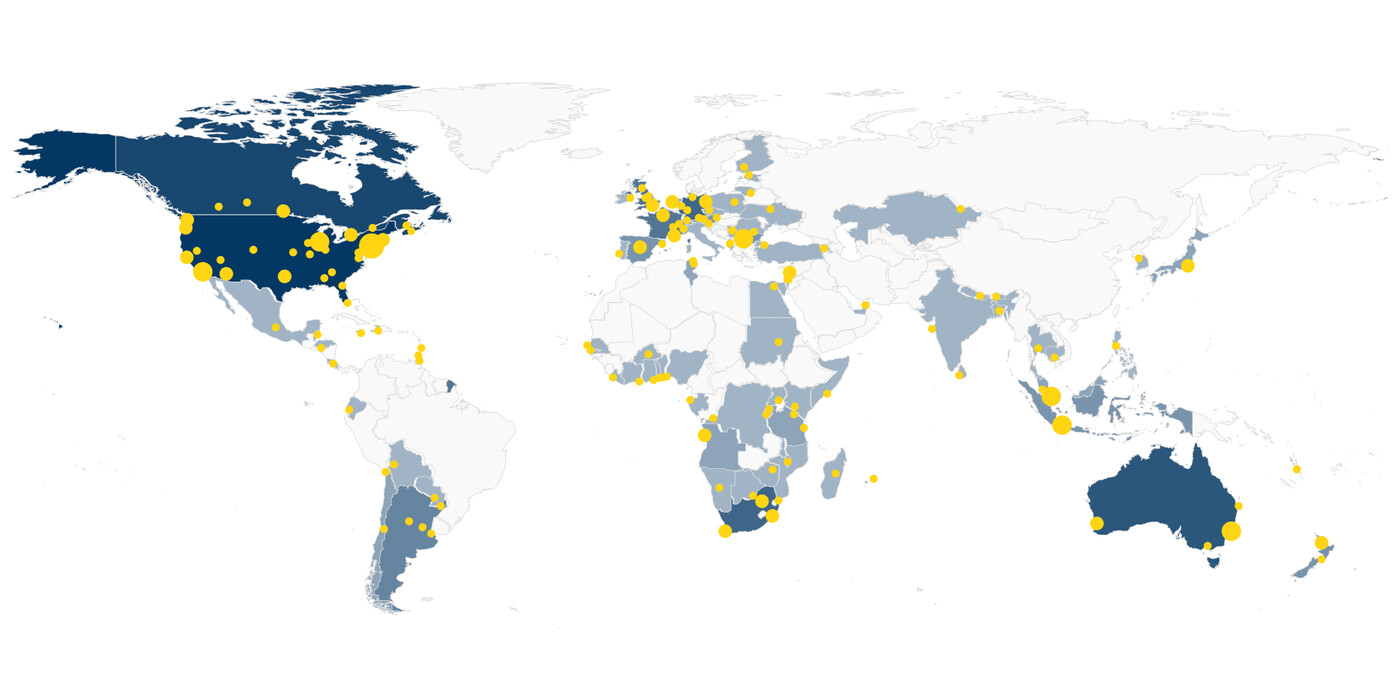
Applying a national ruling to a global anycast service exports it, because the only signal available is an IP address and addresses do not respect jurisdictions. Mobile operators span borders, corporate WANs split across nations, VPNs exit in France while serving users elsewhere.
For cloud security teams this lands oddly. The usual question is who can reach in; this one is where your traffic appears to come from on the way out. A workload in Frankfurt egressing through a NAT gateway whose address space geolocates to France is French to a resolver with no other way to decide. Nothing in your configuration changed, and your resolution behaviour did.
One name, three answers, on the same afternoon
The table above is the real finding. On 23 November one domain from the beIN list, queried from France, came back blocked at Google, answered at Cloudflare and, next morning, refused at Quad9. The zone did not change; the authoritative servers returned identical data to all three. The divergence is downstream, in recursive-resolver policy, and invisible to the domain owner.
What should give operators pause is Google. TorrentFreak found it still applying beIN's notice to the six domains in the original order after that order expired, and blocking 22 of 118 names, down from 91 in October as later notices lapsed. A blocklist can outlive the instrument that created it, decaying on its own schedule inside each operator that holds a copy.
Encrypted transport does not help and may hurt. A device pinned to a Quad9 DNS over HTTPS endpoint completes its TLS handshake, gets a valid HTTP response, and finds a refusal inside it. Because an encrypted endpoint set in a browser or mobile profile ignores what you hand out over DHCP, the resolver change you push never reaches it.
What depends on resolution that you are not counting
It is tempting to file this as a browsing problem. Server infrastructure that never serves a page resolves constantly: mail servers doing MX, SPF and DMARC lookups, agents fetching packages, certificate clients reaching ACME endpoints, backup jobs addressing object storage. A host that cannot resolve does not say so. It reports a hundred unrelated failures.
This inverts the failure teams are drilled on. A DDoS attack has a remedy you can buy and an operator you can call; the timeline is hours. Here the remedy is a filing and the timeline a court calendar. A zero-day vulnerability, for all its noise, ends in a patch and a version number. This ends in a judgment, and no build fixes it.
What to check this week
Start with egress, not endpoints: establish which public addresses your sites leave from, including VPN concentrators, SD-WAN breakouts and cloud NAT gateways, and check how each geolocates. That is the only input the decision uses. Then enumerate the resolvers in play: DHCP option 6 on every scope, static entries on servers and appliances, /etc/resolv.conf baked into container images, Private DNS on managed Android devices, encrypted DNS profiles on managed Apple devices, and any hardcoded 9.9.9.9 in application config or firewall rules. Pick a replacement deliberately rather than taking whatever the ISP hands out; our comparison of the best public DNS servers sets out the trade-offs between filtering, privacy and response time. Finally, make monitoring fail on RCODE 5 and on any Extended DNS Error, and record the error text, because that is where the reason lives.
The part that does not go away
Quad9's exit is not isolated, which is why Cloudflare called it a canary. Cisco pulled OpenDNS out of France and Portugal before it, and a Belgian order would require Cloudflare, Google and Cisco to block through their public resolvers from early January 2027; the three have appealed jointly.
Reasonable people disagree about whether resolver blocking is an appropriate remedy for infringement, and this is not the place to settle it. The operational consequence is not a matter of opinion. IT security has always treated a name as a global fact: ask any resolver, get the same answer, and if you do not, suspect a hijack. That assumption is now wrong by design, in more jurisdictions each year, for lawful reasons. A mismatch between resolvers is no longer, by itself, evidence of an attack.
Which leaves a question that used to be rhetorical, and is the core DNS security discipline from here: for each of your sites, do you know which resolver answers it, which country that resolver thinks it is in, and what it is not telling you?
Sources
- TorrentFreak — Quad9 exits France as expired piracy order lingers at Google and ISPs
- Quad9 — Quad9 service deactivation in France
- Cloudflare — Quad9 withdrawal from France, a canary in the coal mine
- CircleID — Quad9 withdraws DNS service from France, warns of cross-border disruptions
- CyberInsider — Quad9 to leave France after court orders piracy-related DNS blocking
- BetaNews — Quad9 pulls free DNS resolver from France after beIN ruling
- Quad9 — There is strength in numbers
Related articles
Browse every DNS news article by month →
DNS angle
Review resolver logs for the systems discussed above and compare unexpected names with your approved services. A successful lookup does not establish that a destination is safe. Use the DNS lookup tool to inspect current answers, then compare them with your own resolver and incident records.
Source: TorrentFreak — Quad9 exits France as expired piracy order lingers at Google and ISPs ().