Enterprise IT News
Enterprise IT News Alert: Two vCenter Flaws, One Key
By Nattapong Sukkasem · Published · Updated .
TL;DR — Broadcom disclosed CVE-2026-123890 on 19 November, a flaw quoted at CVSS 9.8 that hands an unauthenticated attacker a session as administrator@vsphere.local on a VMware vCenter Server. Google Threat Intelligence Group and Mandiant say a suspected China-nexus group they track as ARMORY CASTLE, formerly UNC5221, had used it since early September. The detail that should change your remediation plan is in their report rather than the advisory: the vCenter they compromised was already patched for July's similar flaw. This enterprise IT news analysis is about why one fix did not cover the other.
Two vulnerabilities in the same VMware component, disclosed sixteen weeks apart, reach the same prize by different roads. That sentence is the whole of this enterprise IT news story, and why a patched management server ended up in an incident report. Broadcom shipped the second fix on 19 November and Google published its account the same day, roughly ten weeks after first observed use.
What Broadcom shipped on 19 November
CVE-2026-123890 is rated 9.8 and affects vCenter Server across the supported branches, including the builds bundled into Cloud Foundation and the Telco Cloud products. There is no published workaround.
| Product | Affected branch | Fixed in | Note |
|---|---|---|---|
| VMware Cloud Foundation / vSphere Foundation | 9.1.x.x | 9.1.1.0200 | Current train |
| VMware Cloud Foundation / vSphere Foundation | 9.0.x.x | 9.0.2.0200 | Current train |
| VMware vCenter Server | 8.0 | 8.0 U3m | The build most estates are running |
| VMware vCenter Server | 7.0 | Broadcom Support | Past general support; extended contracts only |
| VMware Cloud Foundation | 5.x | 5.2.5 | Bundled vCenter |
| VMware Telco Cloud Platform | 3.0, 4.x, 5.0.x, 5.1.x, 5.2 | vCenter 8.0 U3m | Sequence per Broadcom KB463116 |
| VMware Telco Cloud Infrastructure | 3.0 | vCenter 8.0 U3m | Sequence per Broadcom KB463116 |
One row needs a caveat. The Hacker News reports the 7.0 line as a support-contract conversation; SOC Prime calls it past general support with no generally available fix. Either way, the answer is not a download link.
One session key, two routes to it
The defect lives in the VMware Directory Service, which backs vCenter Single Sign-On. Google describes it as an unauthenticated Secure Remote Password session key disclosure over DCE/RPC, answered on TCP 2012, the control interface RPC for SSO.
Secure Remote Password is a password-authenticated key agreement protocol whose appeal is that the server never holds anything replayable. Both sides derive a shared session key, written K, and knowing K is equivalent to having authenticated. The flaw is not in the mathematics. Google names it precisely: predictable UUIDv1 timestamp generation in the SRP authentication interface. A version 1 UUID is built from a clock reading and a node identifier, which makes it unique but not unpredictable, and a value treated as unguessable was in fact a function of time. From that, K falls out without any password.
Mandiant recovered the exploitation tool, a Go utility it calls BONESAW. Google writes that it exploits a cryptographic logic and authorization flaw in the rpc_srp_verifier service over port 2012, exposing a shared session key usable to create authenticated sessions as administrator@vsphere.local. No credentials, no user interaction, no phishing step.

The compromised server was already patched
On 29 July, VMware disclosed CVE-2026-59309, a different vCenter authentication bypass. SOC Prime characterises it as malformed authorization tokens sent to the directory service over LDAP. Different protocol, different code path, same component.
Google states the overlap in one clause: what the two bugs share is primarily the obtaining of the shared session key K without knowing the password. The July fix closed a road to K. It did not make K harder to reach by other roads. And Google reports that the early-September intrusion ran BONESAW against a vCenter that had already taken the July patch.
Most enterprise IT news about a patch measures the gap between disclosure and deployment. Here the useful gap is between two patches. A team that applied CVE-2026-59309 promptly in August did everything the industry asks and was compromised in September anyway, because the first fix was scoped to a route rather than to the asset the route led to. That is no criticism of maintainers who fixed the bug reported to them; it is a reason to read a repeat finding in one component as evidence about the component. When the same secret is reachable twice, the second time is not a coincidence. One open question sits beside it: BONESAW carries a Go build timestamp of 13 July, sixteen days before the July flaw was public, though Google notes such metadata can be forged.
What an administrator session is worth
The tradecraft decides your remediation scope. Google describes a chain that reached vCenter from inside, entering through a BeyondTrust Remote Support zero-day, CVE-2026-102764, and crossing Linux appliances with no endpoint agent. There the group dropped two JSP webshells, SLIMSAVAGE and CAGEMATCH, escalated to root by setting SUID on /bin/env with gdb, then pulled in its toolkit.
The work on vCenter is brisk, and almost all of it legitimate administration. BONESAW creates a single sign-on administrator account and extracts the directory database, /storage/db/vmware-vmdir/data.mdb, through the vmdirdbcp interface. SOC Prime adds that the Security Token Service SAML signing key, the master encryption key and PostgreSQL credentials went with it. A second Go tool, SAWSNAKE, forges SAML assertions from that signing key: valid tokens for arbitrary users, generated offline, indifferent to multi-factor policy. A Dropbear-derived backdoor, BEARBONES, opens listeners on TCP 53 and TCP 33992 and logs plaintext credentials. SSH is switched on through a PUT to /rest/appliance/access/ssh, used, and switched off again.
Then the estate. With vCenter comes vpxuser and root on the ESXi hosts, an attacker key appended to root's authorized_keys, VMFS volumes mounted, and a Python utility reading guest disks directly to lift NTDS, SYSTEM, SECURITY and DNS files out of a Windows virtual machine without logging into it. A separate appliance received LAZYBONES, a Go backdoor polling a Slack channel over HTTPS with 150 to 450 seconds of jitter.
Why the management plane is the estate
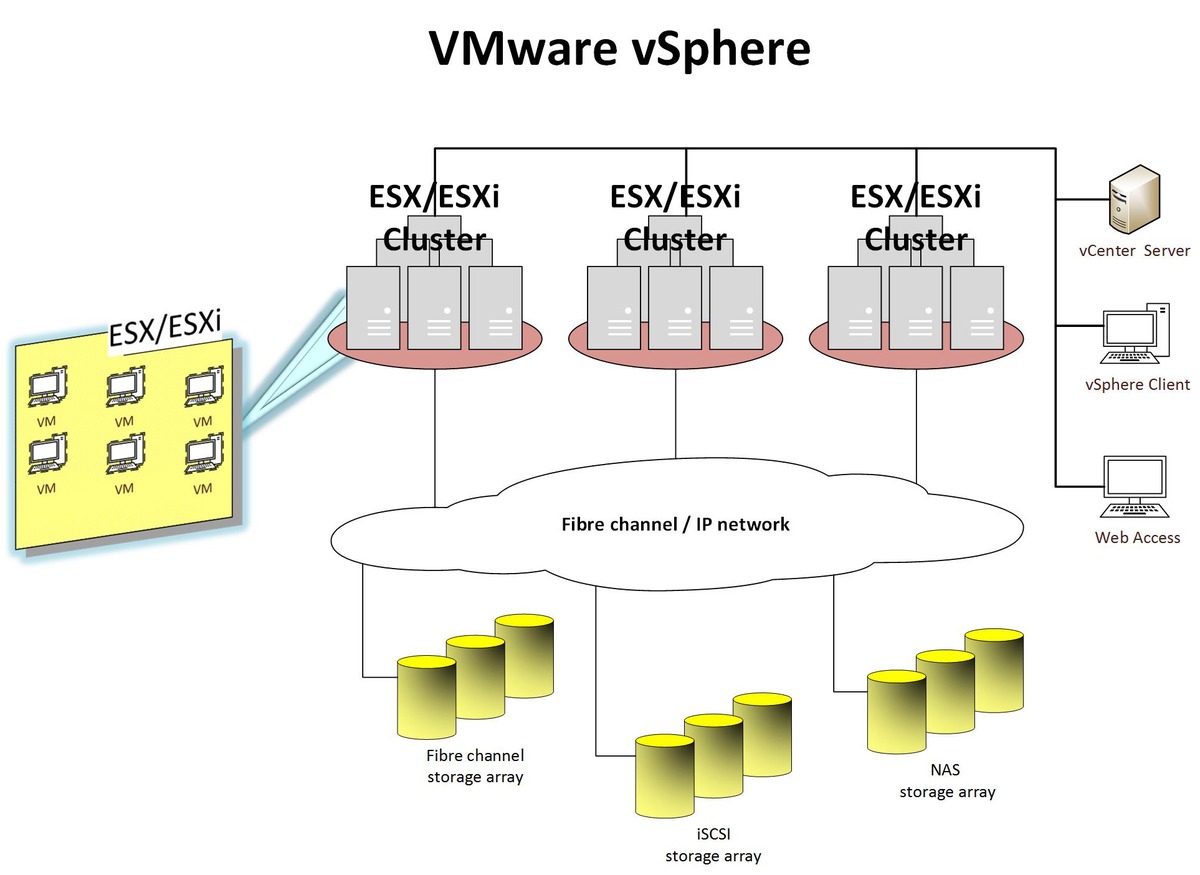
vCenter is server infrastructure whose job is to administer other server infrastructure, and the diagram above makes that inversion obvious: one modest appliance holding the keys to every host, guest disk and datastore beside it. Cloud security is normally a question about somebody else's data centre; a vSphere estate is the case where the cloud is yours and the control plane answers on your own corporate network.
That reachability is the exposure. A DDoS attack announces itself in the first minute, the one mercy of volumetric traffic; this is the inverse trade, a single well-formed RPC call that leaves a successful administrator login in the log and nothing else. IT security programmes are built around a perimeter, and TCP 2012 is almost never on anyone's diagram of it.
What to do now
- Patch to the exact build — 9.1.1.0200, 9.0.2.0200 or 8.0 U3m — sequencing Cloud Foundation and Telco Cloud per Broadcom's KB. There is no workaround, and Google says plainly that reactive patching alone is insufficient here.
- Treat the patch as the start of the investigation. Nothing in the fix removes an account an intruder created. Enumerate SSO administrators, look for the
sps-naming pattern Mandiant observed, check ESXi rootauthorized_keys, audit VAMI SSH toggles and review reads ofdata.mdb. If anything turns up, treat the SAML signing key and the master encryption key as exposed; password changes alone will not help. - Put an access list in front of port 2012. Mandiant publishes a vCenter appliance hardening tool that restricts the SSO RPC interface to allowlisted addresses and bridges iptables logging into a SIEM. Treat 2012, 5480 and 9080 as management-only, and prove it from a workstation.
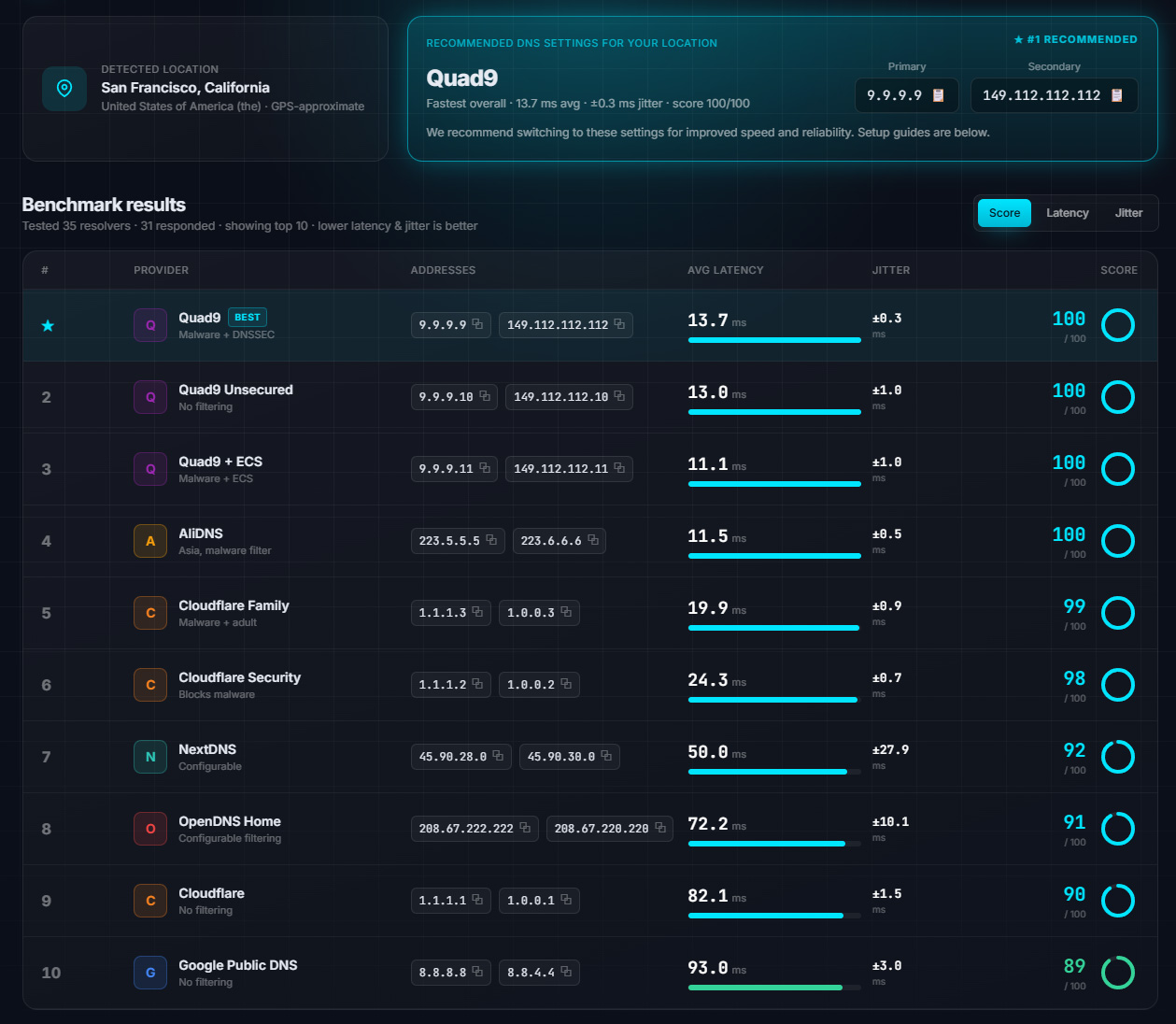
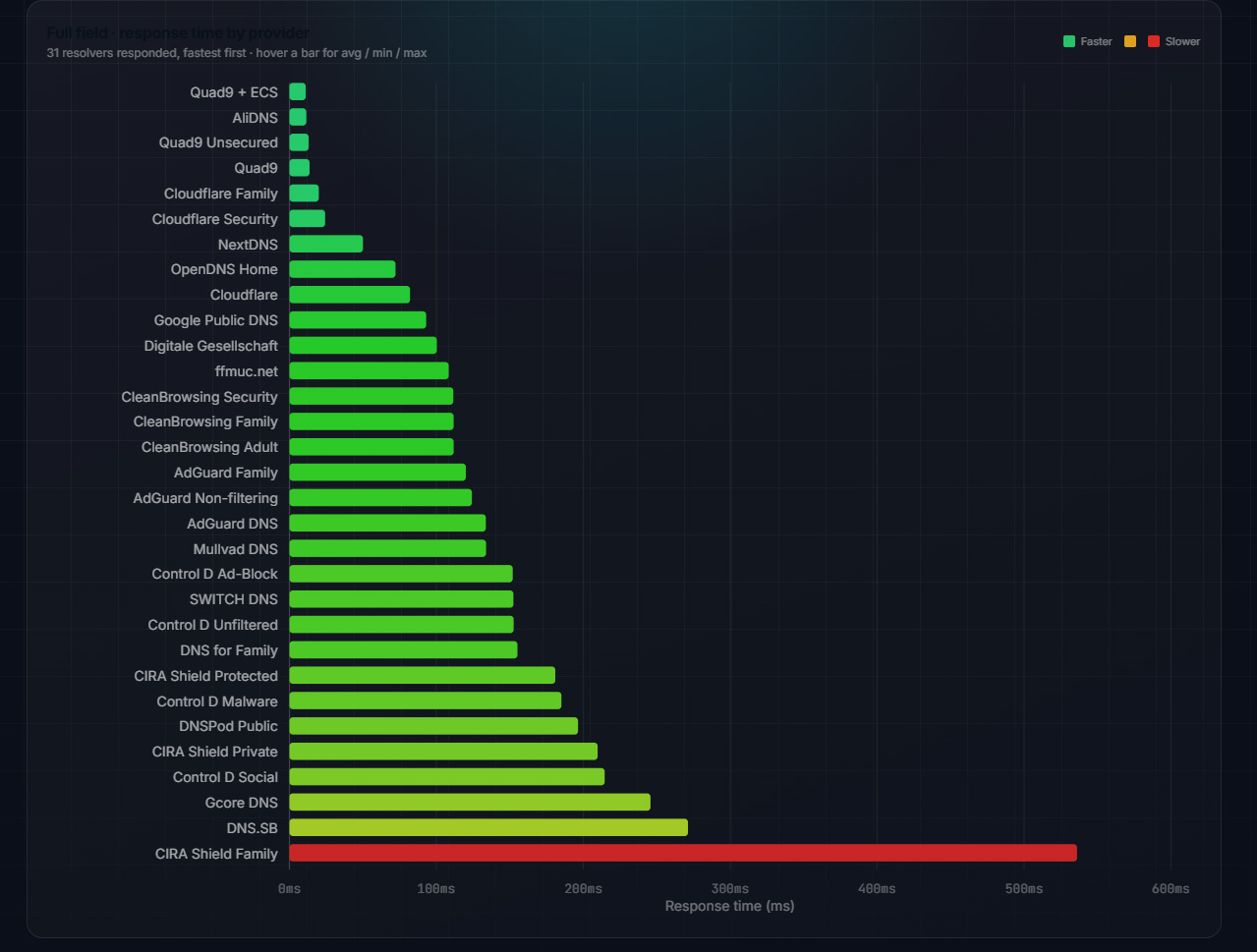
- Watch the names your appliances resolve. LAZYBONES beacons to a Slack channel, so its lookups resolve a hostname most organisations already allow and the only tell is the rhythm, recorded nowhere but the resolver. Appliances rarely let you set a resolver per host, so the gateway is where this is settled — our guide to changing DNS on your router covers pointing a whole segment at one logging resolver. If DNS over HTTPS is enabled on that path, the only record of the beacon has left your logs.
- Capture resolutions while they are live. Before you rebuild, resolve every unfamiliar name found on the appliances with a network diagnostic tool and file the answer with the case. Attacker infrastructure rotates within days, and the lookup you did not record is the one the investigation will want.
Why it matters
A zero-day vulnerability is measured by the length of the silence, and ten weeks of it against virtualisation management is a long time to hold every guest disk in an estate. No CISA Known Exploited Vulnerabilities entry for CVE-2026-123890 is reported, and the four flaws CISA added on 19 November are unrelated; Censys found no public exploit code after disclosure. Both are comforts with short shelf lives.
The durable lesson of this enterprise IT news cycle is about what a patch promises. The July fix was correct and it was applied, and it bought less than its number implied, because the thing worth stealing was never the bug but the key behind it. When one component is breached twice in four months through different doors, the honest question is not whether you are current. It is what a compromise of that component would still be worth on the day after you patched.
Sources
- Google Threat Intelligence Group and Mandiant — ARMORY CASTLE exploits vSphere
- The Hacker News — China-linked hackers exploit critical VMware vCenter zero-day
- SOC Prime — CVE-2026-123890: VMware vCenter zero-day exploited by China-linked hackers
- SC Media — Broadcom patches critical VMware vCenter vulnerability exploited by state-sponsored hackers
- CISA — CISA adds four known exploited vulnerabilities to catalog
- Mandiant — vCenter Server Appliance hardening tool
Related articles
Browse every DNS news article by month →
DNS angle
Review resolver logs for the systems discussed above and compare unexpected names with your approved services. A successful lookup does not establish that a destination is safe. Use the DNS lookup tool to inspect current answers, then compare them with your own resolver and incident records.
Source: Google Threat Intelligence Group and Mandiant — ARMORY CASTLE exploits vSphere ().