Cybersecurity News
Cybersecurity News Alert: Which PHP Default Just Changed?
By Nattapong Sukkasem · Published · Updated .
TL;DR — PHP shipped 8.5.13, 8.4.28, 8.3.37 and 8.2.36 on 19 November, alongside PHP 8.6.0, closing seven critical flaws quoted at CVSS 9.2. The headline bug, named phpAfterShell by the security firm Depthfirst, lets an interrupted write to a session file be reassembled into an attacker-chosen object on the next request. PHP warned a day earlier that the critical issues would need non-default configuration. The release itself switched off a setting that had been on by default, and the notes do not say so. This cybersecurity news analysis is about that gap.
The PHP project told the internet what was coming before it arrived. A notice on 18 November announced releases for the following afternoon and said the issues rated CRITICAL would require either non-default configuration or uncommon setups. It is also the part of this cybersecurity news story worth examining closely, because the two session flaws at the centre of the release turn on settings that PHP ships switched on, and one of those defaults is switched off by the release that fixes them.

What shipped on 19 November
The release carries seventeen or eighteen CVEs depending on who is counting. Chainguard tallies seventeen across the branches; Astra counts eighteen in the 8.5 series alone. Nothing below depends on which is right. Both agree on the number that does matter: seven are critical, and all seven are quoted at 9.2 on the CVSS 4.0 scale, a score the maintainers assigned and that php.net itself does not print. PHP 8.1 and earlier are end of life and receive nothing. PHP 8.2 joins them on 31 December 2026.
One of the seven, CVE-2026-129481, is listed as an incomplete fix for CVE-2026-109619 — one of the two October bugs collectively called PHP2Shell, both of which CISA added to its Known Exploited Vulnerabilities catalogue late last month after real attacks. October's emergency release did not finish the job.
| CVE | Component | Fixed in | What it needs |
|---|---|---|---|
| CVE-2026-126714 | File session storage | 8.2.36 and later | Influence over session data, an interrupted write, a gadget chain |
| CVE-2026-115560 | Session upload progress | 8.2.36 and later | A serializer switched at runtime before session_start() |
| CVE-2026-129289 | PHP-FPM | 8.2.36 and later | Persistent backend connections and an unread request body |
| CVE-2026-129496 | Timezone cache | 8.2.36 and later | Nothing stated beyond remote reachability |
| CVE-2026-129481 | Session shutdown | 8.3.37 and later | An interrupted session cleanup in a reused worker |
| CVE-2026-129474 | Magic method backtraces | 8.5.13 only | Control of allocation shape plus a fatal error at the right moment |
| CVE-2026-129182 | Fatal error backtrace | 8.5.13 only | Repopulation of a global after shutdown |
phpAfterShell, or what a half-written file becomes
CVE-2026-126714 is the one to read twice, because the defect is not in any line of PHP that parses untrusted input. It is in the shape of the file PHP writes. A session file stores each value as a name followed by serialized data, and length fields mark where strings end. Nothing in the format marks a write as finished. PHP locks the file while it writes, and the lock is honoured exactly as designed — but a lock makes concurrent writes mutually exclusive, not atomic. If the worker dies partway through, the file keeps the head of the new record and the tail of the old one, and the result is not corrupt. It is a well-formed session describing contents nobody ever wrote.
The execution step is the part most coverage skips. The trigger is session upload progress. When that feature is on, a multipart upload carrying the progress field makes PHP write to the session during request parsing, before a line of application code runs. The application needs no upload page anywhere; it needs only some page that later calls session_start(). Choose the length fields in the new data carefully and the surviving tail of the old data parses as an additional record, and that record can be a serialized object. The next request to open the session instantiates it.
Stopping the write mid-flight is the awkward part. In Depthfirst's Linux testing the execution timeout fired only after the write had completed, so they used an out-of-memory kill instead. A DDoS attack works by finishing too many requests; this works by not finishing one, and the lever is a resource limit rather than a volume of traffic. The planted object appeared on the eleventh attempt in a fresh run, and the researchers are careful that this measures getting the file into the right state, not how often code execution follows.
The public proof of concept plants a harmless built-in stdClass and stops. Depthfirst's own chain needed no application gadget at all: it used a second bug, a memory-corruption flaw in one of PHP's built-in classes, withheld for coordinated disclosure, and nobody has said whether Wednesday's release closes it. Code execution is also not the only prize, because the same technique can replace a session value before the application reads it — a login flag, a permission, a CSRF token.

The defaults the advance notice did not mention
Both session paths depend on configuration. CVE-2026-126714 needs session.save_handler set to files, which is PHP's documented default. It needs session.upload_progress.enabled switched on, which was also the documented default and was on in the October builds. Astra's detection guidance treats both as in scope when unset. Most cybersecurity news about a scheduled release reports what the advisory said. The more useful comparison this week is between what the advisory said in advance and what the source tree did on the day, because the two do not quite agree.
The Hacker News compared the October and November sources and found that the November release switches session.upload_progress.enabled off by default. The release notes do not mention the change and the project has not commented on it. That is not bad faith: a maintainer writing a pre-release notice has to describe an unpublished bug without handing anyone a map, the advance language was chiefly about the separate CVE-2026-115560, and PHP Foundation executive director Elizabeth Barron is quoted describing that one as needing a very unlikely combination of configuration and application code. But a default change and a patch shipping together are two statements about how common a configuration was, and they point in different directions. The patch is the one to act on; the default change is the one to read.
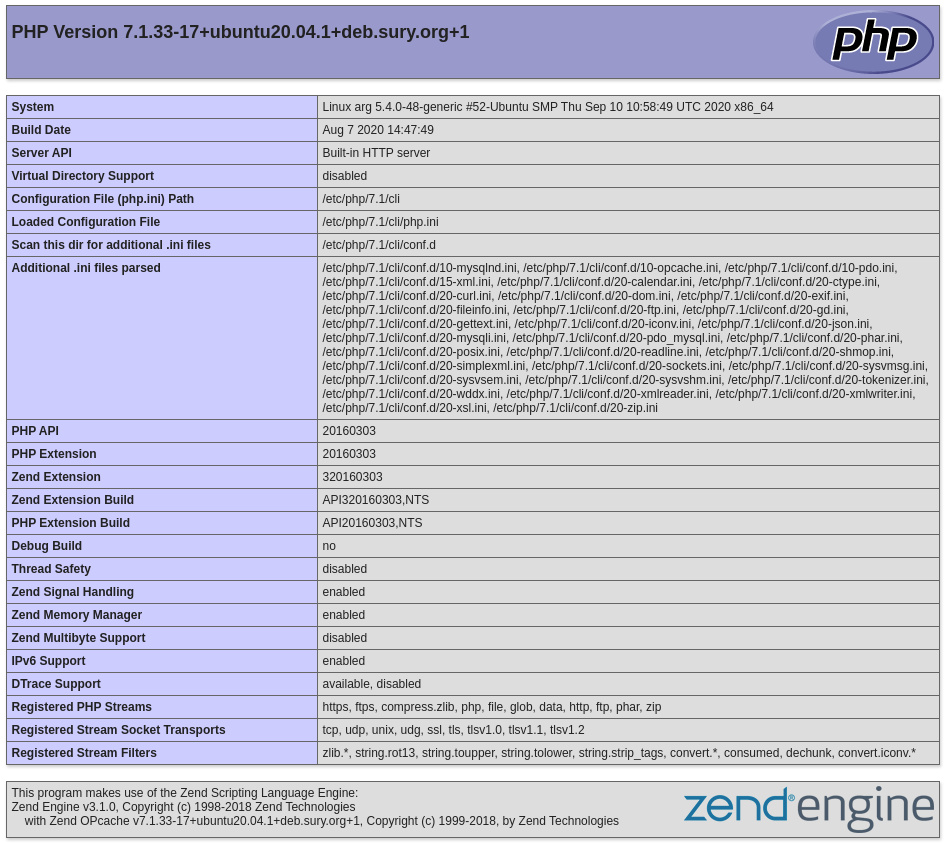
phpinfo() page. The version is old; that is not the point: note the loaded php.ini, the two dozen further fragments parsed beneath it, and a version string stamped by a distribution rather than upstream.Why your configuration is harder to state than it looks
PHP is server infrastructure that nobody sells you. It arrives inside a distribution package, a container base image or a hosting panel, and the organisation that fixed it has no account manager to ring. The consequence is in the screenshot above: the effective configuration is assembled from a php.ini plus a directory of fragments, and a distribution may ship the fix while leaving the version string alone. Cloud security here is a build question rather than a server question, because a running container never updates itself; the fix lands when the image is rebuilt, and an image pinned to a digest stays vulnerable for as long as that pin holds.
What to do now
- Upgrade the branch you actually run — 8.5.13, 8.4.28, 8.3.37 or 8.2.36 — then restart every worker: FPM masters, mod_php, embedded runtimes. A patched binary on disk behind a process started last Tuesday is not a patched service.
- Read the configuration rather than recalling it. Run
php --inion each web host and container to list every file in force, then grep that set forsession.save_handlerandsession.upload_progress.enabled. An explicit= 1written by a panel or a package survives the new default. If you cannot patch this week, setting it to0in an FPM pool is a stopgap beside the upgrade, never instead of it. - If you move sessions to Redis or a database, which does avoid the torn-write class, understand what you have added: a hostname in the authentication path, resolved on every request that opens a session. Whether DNS over HTTPS or your own resolver answers that lookup decides whether a login failure is debuggable, and our DNS configuration guides cover where that is settled.
- Record what an unfamiliar destination resolves to. If you find an unexpected object or an unknown name in session data, resolve it with a network diagnostic tool and keep the answer. Attacker infrastructure rotates, and the resolution you did not capture is the one the investigation will ask for.
- Decide who owns the answer. Which PHP binary serves your web requests is an IT security question before it is a platform-engineering one, and on most estates nobody has written it down.
Why it matters
A zero-day vulnerability is defined by the defender having no warning, and this release is the opposite case. PHP gave a day of notice, named a severity and described the shape of the preconditions. Everyone got a day to prepare, and so did everyone else. That is the trade a scheduled disclosure makes.
The durable lesson of this cybersecurity news cycle is about the word default. A torn write has sat in the reliability column of design reviews for thirty years, because the worst case was understood to be a lost session and a user logged out. phpAfterShell moves it into the security column by pointing out that a format with length fields and no commit point does not produce broken files — it produces different ones. Nobody needs to have made a mistake for that to be true. The configuration was shipped, the lock worked, the file parsed, and the object arrived anyway.
Sources
- PHP — ChangeLog for PHP 8, November 2026 security releases
- The Hacker News — phpAfterShell explained: how hackers could turn a PHP session flaw into code execution
- The Hacker News — PHP fixes 7 critical flaws, including bugs that could allow remote code execution
- Chainguard — PHP November security release: what it is and what to update
- Astra — PHP critical security release, 19 November 2026
- Security Affairs — PHP warns of critical flaws ahead of November security release
- The CyberSec Guru — PHP security release 19 November 2026: critical flaws explained
- Cyber Security News — PHP security team warns of critical vulnerabilities
Related articles
Browse every DNS news article by month →
DNS angle
Review resolver logs for the systems discussed above and compare unexpected names with your approved services. A successful lookup does not establish that a destination is safe. Use the DNS lookup tool to inspect current answers, then compare them with your own resolver and incident records.
Source: PHP — ChangeLog for PHP 8, November 2026 security releases ().