Threat Intelligence
Cybersecurity News: An AI Agent Breached Korea’s Banks
Published October 12, 2026 · DNS Benchmark Pro Editorial · Reading time: 7 minutes
TL;DR — CrowdStrike reported on 7 October 2026 that intrusions at South Korean financial institutions were run using ARTEX, an open-source agentic penetration-testing framework released in July and pulled from GitHub on 8 October. The operator left open directories exposing agent session histories, configuration files and a Chinese-language prompt file. Korean media put the exposure at roughly 68,000 people across several lenders, including about 25,000 Shinhan Bank customers; the Financial Services Commission called an emergency meeting and ordered banks to inspect every externally reachable system. No CVE has been published and no zero-day is involved. What makes this cybersecurity news rather than another breach notice is tempo — which shows up in DNS telemetry long before an application log.
Most intrusion stories start with a vulnerability. This one starts with a tool. The cybersecurity news worth attention this week is not a novel exploit class but an operational shift: one actor, apparently working alone, ran several intrusions against a heavily regulated banking sector in a short window by delegating the slow parts — enumeration, attack-path planning, verification — to an autonomous agent. The exploitation looks unremarkable. The pace does not.
What CrowdStrike actually reported
CrowdStrike’s Counter Adversary Operations team published its findings on 7 October. The researchers named no adversary group; they assess with moderate confidence that the operator is a Chinese speaker acting for financial gain, based on the Chinese-developed tooling and Chinese-language prompts. The evidence is unusually direct: the operator left directory listings exposed.
| Element | Detail |
|---|---|
| Research | CrowdStrike Counter Adversary Operations, 7 October 2026 |
| Tooling | ARTEX — open-source multi-agent penetration-testing framework, released 26 July 2026 under AGPL-3.0; withdrawn from GitHub 8 October 2026 |
| Models | DeepSeek v4.1-flash primary; GLM-5.3 (Zhipu AI) and Grok 4.6 supporting; separate agent sessions for non-technical tasks |
| Attribution | No named adversary; moderate confidence the actor is a Chinese-speaking, financially motivated individual |
| ARTEX host | 38.244.50[.]120, carrying an exposed directory and a Chinese-language prompt file at /.claude/CLAUDE.md |
| Proxy layer | Nine IP addresses routing activity (MITRE ATT&CK T1090); a Hong Kong-hosted server as primary infrastructure |
| Entry points | A loan-progress inquiry service for financial brokers, and an employee mobile work-support system |
| Reported victims | Shinhan Bank (~25,000 customers), KB Kookmin Bank (119 card records), Hana Bank (limited sales-support compromise); further lenders named in Korean media |
| Reported exposure | ~68,000 people; names, contact details, resident registration numbers, income and loan limits |
| Vulnerability | None published — no CVE and no zero-day vulnerability has been identified in any victim system |
| Official response | FSC emergency meeting, on-site inspections, information shared with KISA; presidential order for a full investigation, 4 October |
| Caveat | Victims and authorities have not confirmed ARTEX as the intrusion method; the link rests largely on the operator’s own logs |

ARTEX orchestrates; it does not think
It is worth being precise about what ARTEX is, because much of the coverage has been loose. ARTEX is not a model. It is a multi-agent orchestrator automating information gathering, vulnerability discovery, attack-path planning, tool execution and verification, calling commercial language models for the reasoning and conventional scanners for the work. Strip away the agent layer and the activity is the same scanning and probing any competent tester would run.
The agent layer changes two things: it removes the human delay between a result arriving and the next decision, and the practical ceiling on how many targets one person can carry. CrowdStrike’s conclusion is blunt: “AI tooling can enable a financially motivated threat actor to conduct multiple intrusions within a short time span.”
The operator’s own hygiene undid them. Open directories on attacker-controlled servers held agent session histories, ARTEX configuration files and memory files. Those sessions also captured non-technical work: asking where Korean breach data is sold, requesting Korean-language Telegram groups, and drafting a résumé describing the results — a document carrying identifying details. Agentic tooling produces a rich forensic artefact: the operator has to write down what they want.
ARTEX was released on 26 July 2026 under AGPL-3.0. Its developer removed it from GitHub on 8 October, announcing a move to closed source and citing misuse. That closes nothing: forks persist, and a Korean derivative has reportedly appeared. AhnLab reportedly observed roughly 600 addresses worldwide hosting ARTEX instances — deployments, not confirmed attacks.
Nine proxies, two servers and one reseller domain
The published infrastructure is instructive: a two-server arrangement — a Hong Kong-based host as primary infrastructure, and a second running the ARTEX instance used against the Korean targets at 38.244.50[.]120 — behind nine proxy addresses. All of that is bare IPv4. Alongside it sits one domain: xcai[.]pro, an API reseller through which the operator likely reached DeepSeek.
That one domain is worth dwelling on, because it is the signature of agentic operations generally. An autonomous attack framework must reach a model, and model access is sold through named services and resellers. Wherever such a framework runs — including inside your own estate — it generates recurring egress to model and reseller endpoints: a resolvable, blockable, loggable artefact in a footprint that is otherwise all raw addresses. A reseller domain registered weeks earlier is exactly the kind of record a WHOIS and RDAP lookup flags on registration age alone.

Why this cybersecurity news is a network diagnostic problem
Consider where the attackers got in: a loan-progress inquiry service for brokers, and a mobile back end for staff. Neither headlines an architecture review. Both are externally reachable, both carry real data, and both almost certainly have a hostname in a zone the bank publishes.
That is the connection to DNS, and it is not decorative. Agentic reconnaissance begins with asset discovery — in practice, systematic enumeration against authoritative name servers, thousands of candidate labels in minutes. It is the first observable in the campaign, it lands on server infrastructure most organisations never treat as a security sensor, and it precedes the first HTTP request by a wide margin.
The diagnostic signatures separate cleanly. A DDoS attack degrades everything reachable through a path at once. A zero-day vulnerability in an exposed service produces crashes, anomalous memory behaviour or unexplained privileged actions. Agentic reconnaissance produces none of that: ordinary-looking traffic, simply faster and more systematic than a human could generate — a high-volume, low-error sweep from a few sources, iterating on each response.
Two notes follow. First, an estate permitting unmanaged DNS over HTTPS egress loses the resolver visibility this depends on; forwarding DoH to a controlled endpoint keeps the log. Second, the FSC’s instruction to inventory every externally accessible system, including non-customer-facing ones, is in effect an instruction to audit the zone file. Your published records are your attack surface inventory, whether or not anyone reads them as one.

What defenders should do this week
- Ingest the published indicators. CrowdStrike listed the ARTEX host and nine proxy addresses. Search historical ingress and egress logs for matches rather than only adding forward-looking blocks.
- Turn DNS query logs into a hunting source. On the authoritative side, alert on enumeration bursts: high NXDOMAIN rates from a narrow set of sources. On the recursive side, watch for sustained egress to model APIs and resellers from hosts with no business reaching them.
- Rebuild the external inventory from the zone outward. Walk your published records and confirm each still points at something you intend to expose — a DNS record lookup across every delegated name is a faster audit than most asset databases allow.
- Rate-limit and bot-manage the unglamorous portals. Broker-facing lookup services and staff mobile back ends deserve the controls normally reserved for the main customer application.
- Segment workforce applications from customer data stores, so a compromised staff tool yields a session, not a database.
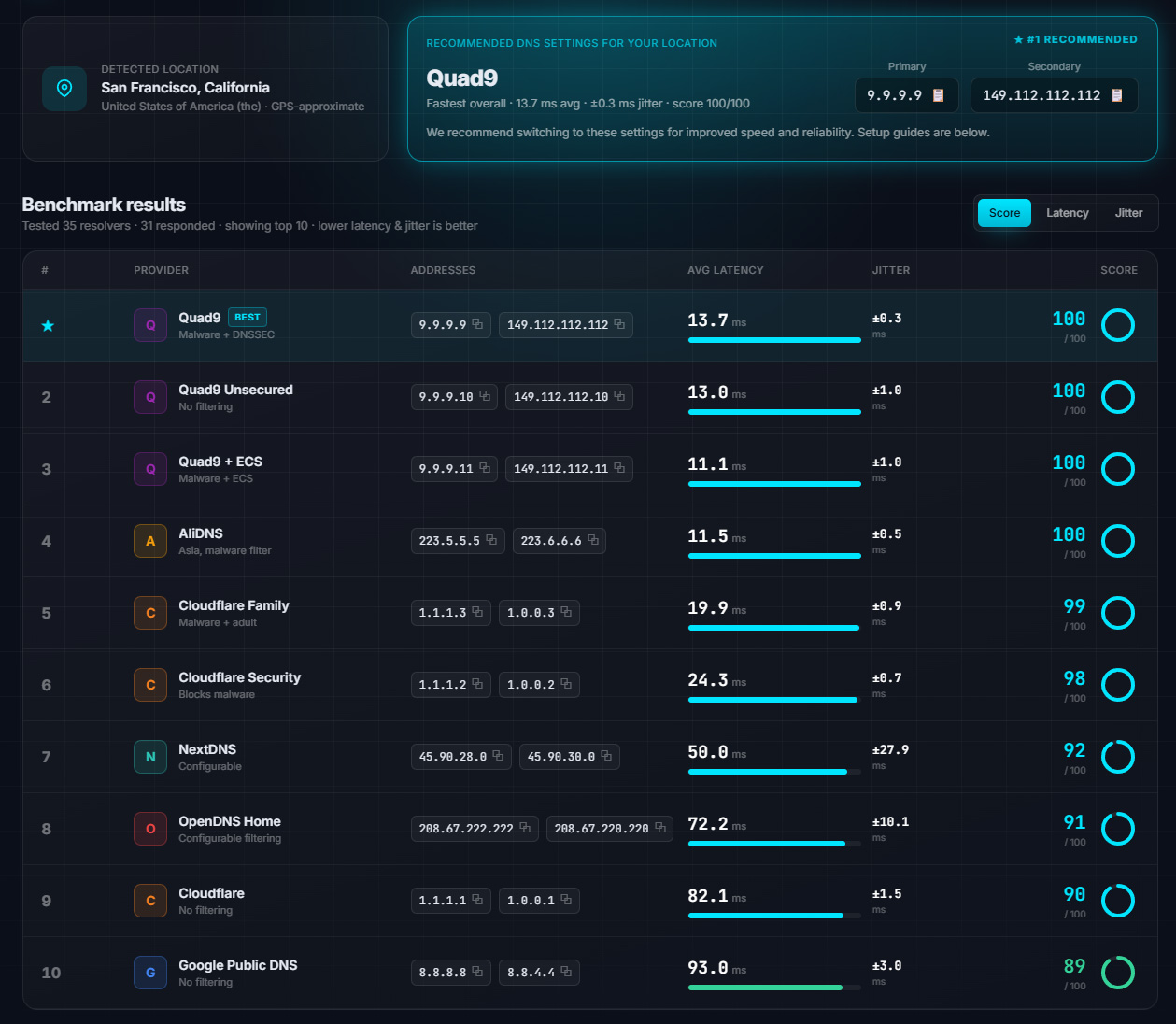
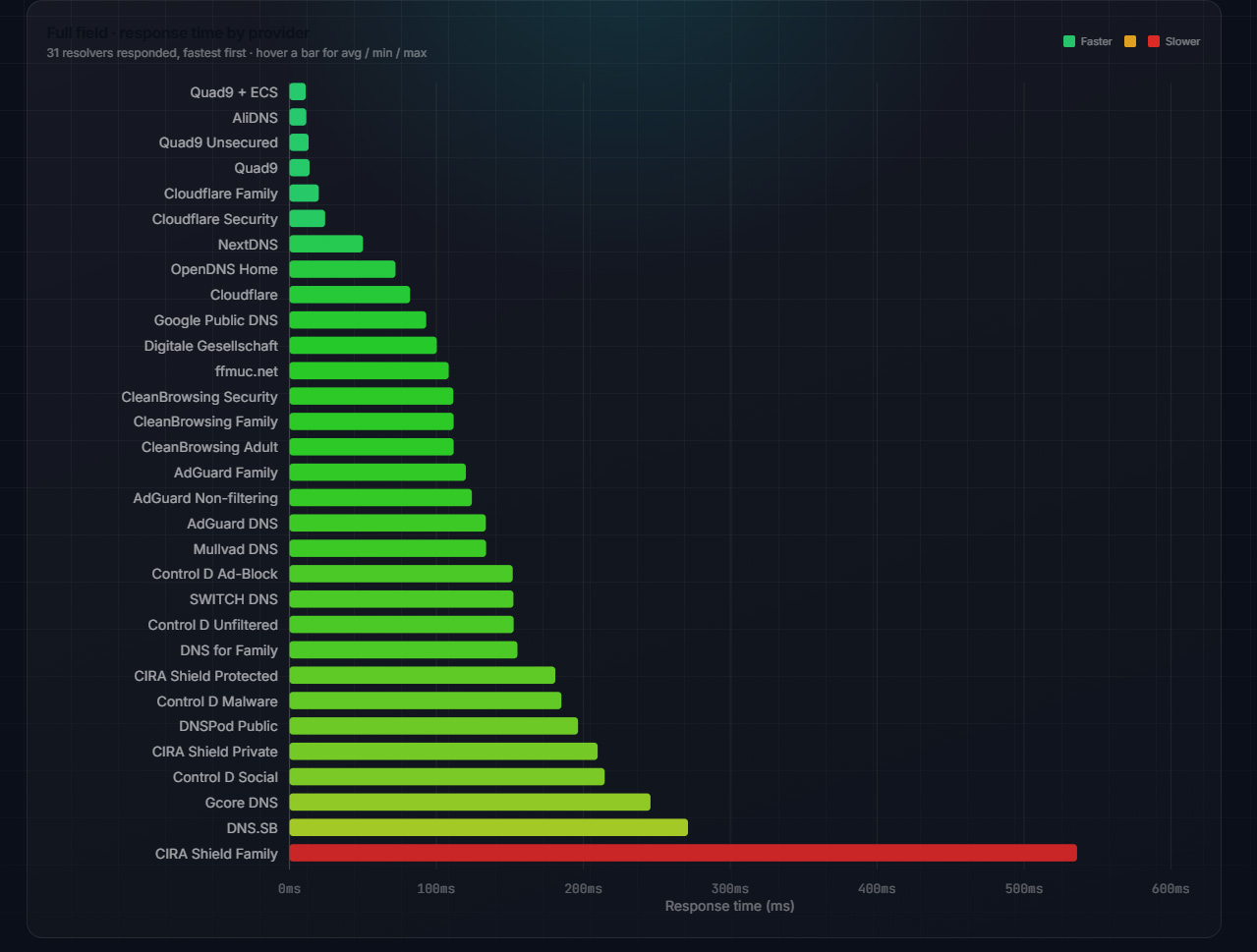
- Baseline resolver behaviour before you need it. Anomaly detection in DNS requires a known-good reference for latency and failure rates — a free DNS benchmark across your resolvers gives you one in minutes.
Industry impact: tempo, not capability
Nothing here required a capability that did not exist in 2024. Scanning, enumeration, credential reuse and poorly segmented staff tools are the oldest material in the field. What changed is how many threads one person can hold at once, and how little time passes between an interesting probe result and the follow-up.
That is an uncomfortable shift for IT security programmes calibrated to human attacker tempo — the part of this cybersecurity news that outlasts the incident. Detection windows measured in days assumed reconnaissance took days; a weekly external scan assumed the attacker’s was no faster. Neither holds against an orchestrator that never pauses, and the same applies to cloud security postures built on periodic review of a sprawling external footprint.
Two cautions apply. The ARTEX link rests largely on the operator’s own logs, and neither the victims nor Korean authorities have confirmed the tool as the intrusion method; credential stuffing against weak staff-facing entry points remains a plausible partial explanation. Reported victim counts also vary between outlets, from five institutions to nine. Read this as a directional signal, not a settled case file.
The signal itself is clear. Agentic tooling is cheap, forkable and now demonstrably pointed at regulated financial infrastructure; withdrawing one repository changes nothing. The answer is not a new product but older discipline applied faster: know what you publish, log the layer that sees reconnaissance first, and compress your detection timeline to match the one your adversary bought off the shelf.
Sources
- CrowdStrike — Unknown threat actor uses AI-driven ARTEX to target South Korean finance
- BleepingComputer — ARTEX AI and agent sessions used in cyberattacks on South Korean banks
- BleepingComputer — South Korea probes bank breaches amid suspected AI-powered attacks
- Cloud Security Alliance — Research note: ARTEX, agentic pentesting and the Korean bank breaches
Independent editorial analysis published by DNS Benchmark Pro / Genext Information Systems. The Yeouido skyline photograph is by TurnOnTheNight, via Wikimedia Commons, licensed CC BY-SA 4.0; the Shinhan Bank building photograph is by Mobius6, via Wikimedia Commons, licensed CC BY-SA 4.0; the Shinhan Bank logo is a public-domain file via Wikimedia Commons, reproduced on a dark background; the benchmark screenshots are original captures of the DNS Benchmark Pro engine. No images on this page are AI-generated. DNS Benchmark Pro is not affiliated with CrowdStrike, Shinhan Bank, KB Kookmin Bank or Hana Bank.