Infrastructure
Tech Infrastructure Flaw: Atlassian CVSS 9.3 File Read
Published October 7, 2026 · DNS Benchmark Pro Editorial · Reading time: 7 minutes
TL;DR — On 5 October 2026 Atlassian disclosed CVE-2026-21589, a CVSS 9.3 arbitrary file access flaw that lets an unauthenticated attacker retrieve files from the web application root of eight self-hosted products: Bitbucket, Confluence, Jira Software, Jira Service Management, Bamboo and Crowd Data Center, plus Crucible and Fisheye. All versions are affected, including end-of-life releases. The attacker must already know a file’s exact name and path — directory listing is not possible — which narrows discovery but not impact. Atlassian Cloud is already patched and the company reports no evidence of exploitation. Fixed builds exist for every product; a reverse-proxy or WAF rule blocking traversal sequences is the stopgap. For most organisations this is a tech infrastructure problem, not just an application patch.
The most consequential tech infrastructure advisory of the week landed quietly on Monday. Atlassian published a security bulletin for CVE-2026-21589, an unauthenticated arbitrary file read scored 9.3 under CVSS 4.0, affecting every supported — and every unsupported — version of eight Data Center and Server products. There is no exploitation in the wild as of this writing, no public proof of concept, and no CISA KEV entry. There is also no version of Jira, Confluence or Bitbucket you can self-host today that was not vulnerable before Monday.
What CVE-2026-21589 actually allows
The flaw is a path traversal in the request handling of the affected web applications. A crafted request containing traversal sequences escapes the intended directory boundary, and the server returns the contents of a file inside the web application root to a client that has never authenticated.
Two constraints shape the real-world risk. First, the attacker must know the exact file name and path; the bug does not expose a directory index, so there is no enumeration primitive. Second, the reachable area is the web application root rather than the whole filesystem — Atlassian is explicit that deployments storing sensitive material inside that directory carry elevated risk.
| Element | Detail |
|---|---|
| Identifier | CVE-2026-21589 |
| Severity | CVSS 4.0 base score 9.3 (Critical) |
| Class | Path traversal → unauthenticated arbitrary file access |
| Privileges required | None — no account, no session, no user interaction |
| Affected | All versions of Bitbucket, Confluence, Jira Software, Jira Service Management, Bamboo and Crowd Data Center, plus Crucible and Fisheye |
| Not affected | Atlassian Cloud — already remediated, no customer action |
| Workaround published | 2 October 2026 (attached to a public ticket) |
| Advisory published | 5 October 2026 |
| Exploitation | No evidence reported as of 6 October 2026 |

Why “you must know the filename” is weaker protection than it sounds
Needing a known path reads like a meaningful barrier until you remember that these are off-the-shelf products. Every Jira installation has the same layout as every other Jira installation. Configuration files, bundled property files and the contents of the deployed web archive sit at paths that are published in vendor documentation, visible in public Docker images, and reproducible on an attacker’s own trial instance in minutes. Enumeration is unnecessary when the target ships with a map.
What makes a file read on this particular class of server infrastructure worse than average is the content. A source repository server, an issue tracker and a wiki are where organisations accumulate internal hostnames, service endpoints, build configuration, integration tokens and architecture diagrams. None of that is a breach on its own. All of it lowers the cost of the next step: a credential pulled from a config file, an internal DNS name that reveals a staging environment, an SSO endpoint worth targeting. Information disclosure is rarely the headline incident; it is reliably the first paragraph of one.
The three-day gap between workaround and advisory
The timeline deserves attention from anyone running vulnerability management. Mitigation files were uploaded to a publicly visible Atlassian ticket on 2 October, three days before the formal advisory on 5 October. That is a reasonable engineering sequence — get a stopgap into customers’ hands early — and simultaneously an early signal to anyone watching vendor trackers for pre-disclosure activity.
The practical consequence is that the window did not open on Monday. Teams measuring exposure should treat 2 October as the start of the interesting period in their logs, not the advisory date. This is the same pattern the industry saw with recent edge-appliance disclosures, where a published mitigation told attackers precisely which code path to look at before the patched builds were widely deployed.
Patching, and what to do before you can patch
Fixed builds exist for all eight products. Bitbucket Data Center is remediated in 9.4.26, 10.2.8 and 10.5.1; Confluence Data Center in 9.2.26 and 10.2.19; Jira Software Data Center in 9.12.40, 10.3.26 and 11.3.12; Jira Service Management Data Center in 5.12.40, 10.3.26 and 11.3.12; Bamboo Data Center in 10.2.24 and 12.1.12; Crowd Data Center in 6.3.7, 7.0.3, 7.1.7 and 7.2.4; and Crucible and Fisheye in 4.9.15. Choose the fixed release on your current branch rather than treating this as a major upgrade — the branch-local patch is what keeps the change window short.
- Take the instance off the public internet. If an issue tracker or wiki does not need to be reachable from arbitrary source addresses, put it behind VPN or an identity-aware proxy. This single control neutralises most unauthenticated bugs in this product family permanently.
- Deploy a traversal-blocking rule. Atlassian’s guidance covers web application firewall and reverse-proxy rules for all products, Tomcat RewriteValve rules for several, and a
urlrewrite.xmlrule for Bitbucket. Rules must URL-decode the request up to twice before matching, or encoded variants slip through. - Hunt in access logs from 2 October onward. Look for two dots adjacent to a slash, backslash or double colon, in raw and encoded forms. Absence of hits is weak evidence, but presence is actionable immediately.
- Rotate anything stored in the web application root. If a deployment has placed keys, tokens or credentials there — a common shortcut — treat them as disclosed and rotate rather than reasoning about whether anyone looked.
- Inventory the end-of-life instances. Unsupported versions are affected and will not receive a fix. The decommissioned Fisheye instance nobody owns is the one that will still be answering requests next year.
The DNS security angle: what a file read gives away about your network
There is a reason we keep returning to disclosure bugs on this site. The files that sit in and around a developer toolchain are full of names: internal resolver addresses, split-horizon zones, service discovery endpoints, staging and pre-production hostnames that were never meant to be public. An attacker who reads a build configuration learns your internal naming convention, and an internal naming convention is a target list.
That matters more now that so much corporate traffic rides encrypted transport. DNS over HTTPS protects queries in flight; it does nothing about hostnames an attacker already holds in a configuration file. Treat internal name exposure as part of the blast radius of any file-read vulnerability, alongside the obvious credential risk, and revisit whether split-horizon data is genuinely separated from anything an internet-facing application can reach.
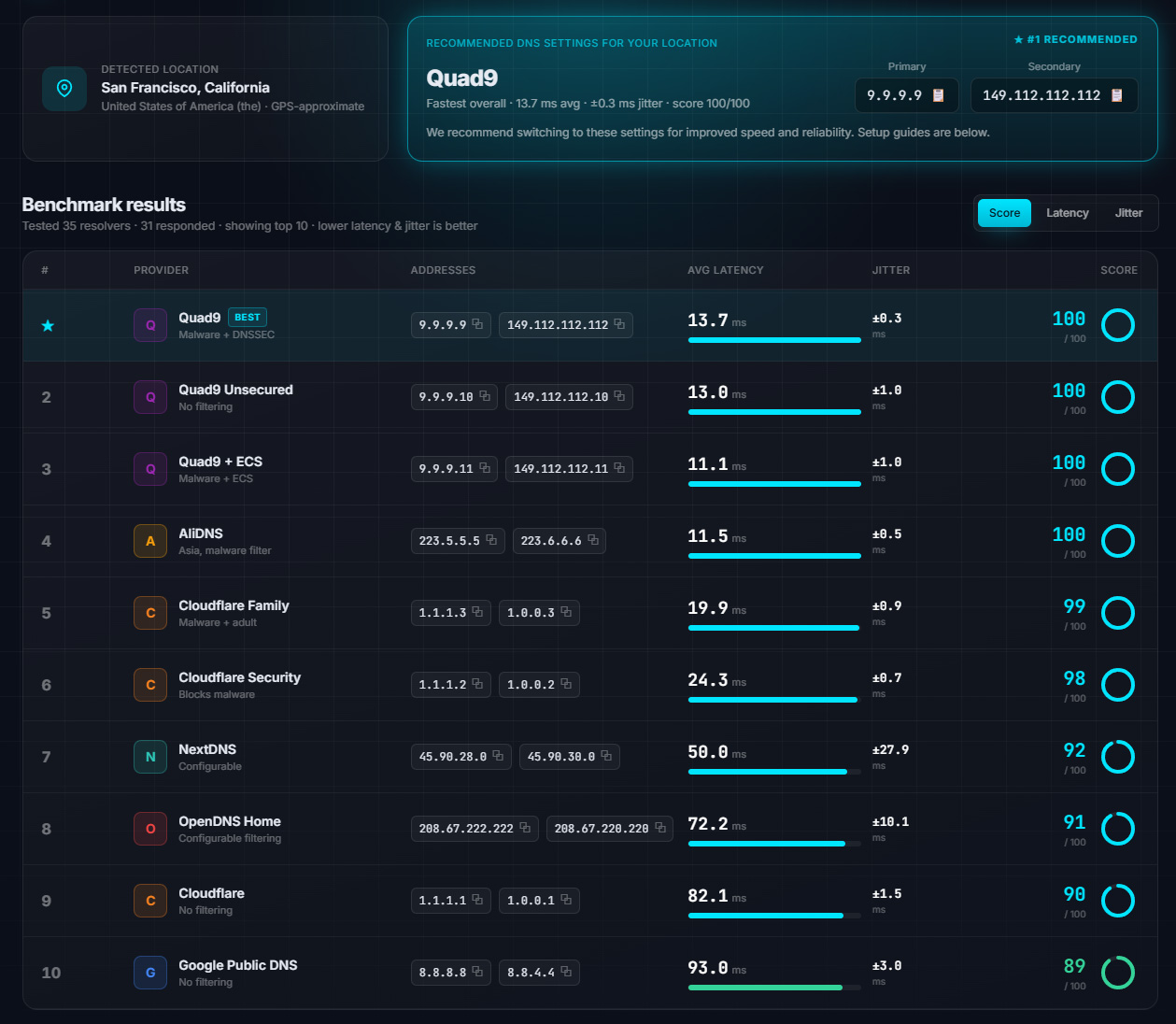
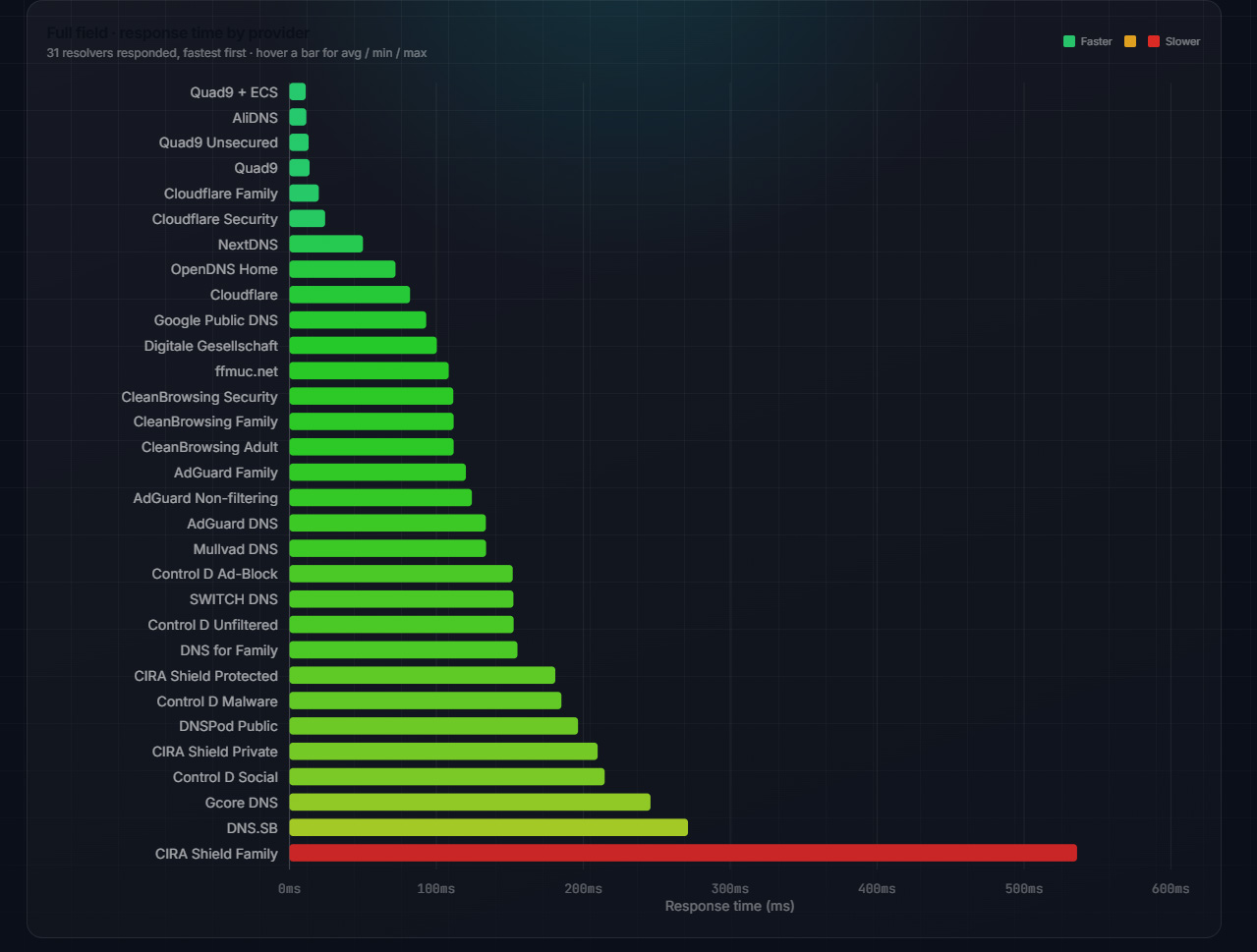
Emergency patching is also when resolution quietly breaks. Restarting application nodes behind a new reverse-proxy rule changes which resolver answers, how long records are cached and whether a health check resolves at all. Running our free DNS benchmark and network diagnostic tool from the affected network before and after the change gives you a measurement instead of an argument. If you are weighing encrypted transport for internal resolvers, our guide to DNS over HTTPS and DNS over TLS covers the caching and connection-reuse trade-offs that decide whether it helps or hurts.
Industry impact: the toolchain is production
Set this beside the Cloudflare Containers cross-tenant leak we covered on 25 September. Different vendor, different mechanism, same uncomfortable shape: a platform most teams treat as supporting cast turned out to be sitting on data that mattered. Issue trackers, wikis and repository servers get classified as internal productivity tools, which is how they end up outside the patch cadence applied to the public web tier and outside the monitoring applied to the database tier.
They do not deserve that classification. A source repository server holds the material from which production is built; a wiki holds the runbooks that describe how production is operated. Compromise either and an attacker does not need a zero-day vulnerability in your edge, because they can read how your edge works. That is also why a disclosure flaw with no code execution, no privilege escalation and no exploitation in the wild still earns a 9.3.
Nothing about this advisory requires heroics. Patch on your current branch, put the instance behind authentication at the network edge, add the traversal rule, read the logs back to 2 October, and rotate anything that was sitting where it should not have been. The organisations that will still be exposed in six months are not the ones that lacked the fix — they are the ones whose tech infrastructure inventory never included the wiki.
Sources
- The Hacker News — Critical Atlassian flaw lets unauthenticated attackers read known files across 8 products
- watchTowr Labs — Atlassian arbitrary file access vulnerability FAQ (CVE-2026-21589)
- SOC Prime — CVE-2026-21589 exposes sensitive files across eight Atlassian products
- Cyber Kendra — Atlassian patches critical file access flaw CVE-2026-21589
Independent editorial analysis published by DNS Benchmark Pro / Genext Information Systems. The Atlassian Central photograph is by Wikimedia Commons user Sardaka, released under CC0; the Atlassian logo is a public-domain reproduction of an official corporate mark, via Wikimedia Commons; the benchmark screenshots are original captures of the DNS Benchmark Pro engine. No images on this page are AI-generated. DNS Benchmark Pro is not affiliated with Atlassian Corporation.