Cybersecurity News
Cybersecurity News: Citrix NetScaler Zero-Days Exploited
Published September 28, 2026 · DNS Benchmark Pro Editorial · Reading time: 7 minutes
TL;DR — The cybersecurity news that should reorder your week: on 27 September 2026 Citrix published bulletin CTX697096 and confirmed that two NetScaler zero-day vulnerability flaws are already being exploited. CVE-2026-88771 is an improper input validation defect allowing unauthenticated command execution, and it affects every NetScaler ADC and Gateway deployment regardless of configuration. CVE-2026-88772 is a memory overflow reachable when DTLS is enabled — the default on VPN virtual servers — leading to remote code execution or denial of service. Both are rated CVSS 9.5. CISA added them to the Known Exploited Vulnerabilities catalog the same day under BOD 26-04 and gave federal agencies until 30 September. Shadowserver tracks more than 23,000 internet-facing NetScaler instances. Fixed builds are 14.1-73.37 and 13.1-64.23. There is no workaround.
There is a particular category of cybersecurity news that does not reward calm reading, and this is one of them. A pre-authentication remote code execution flaw in an appliance whose entire job is to sit on the public internet and terminate remote access is the shortest path an attacker can take into a network. Citrix NetScaler is that appliance for a very large share of enterprise server infrastructure, and this week it has two of them at once.
What Citrix actually disclosed
Bulletin CTX697096 covers eight CVEs. Two matter urgently.
| CVE | CVSS | Class | Precondition |
|---|---|---|---|
CVE-2026-88771 | 9.5 Critical | Improper input validation → unauthenticated arbitrary command execution | None — affects the default configuration of every ADC and Gateway |
CVE-2026-88772 | 9.5 Critical | Memory overflow → RCE or denial of service | DTLS enabled, which is the default on VPN virtual servers |
CVE-2026-88773 | 9.3 Critical | HTTP request smuggling via inconsistent request interpretation | Fixed in the same bulletin |
CVE-2026-88774 – 88778 | 7.0 – 8.8 High | Assorted, including predictable TCP initial sequence numbers | Fixed in the same bulletin |
The denial-of-service half of CVE-2026-88772 deserves its own line in the risk register. An appliance that can be crashed by an unauthenticated DTLS packet gives an attacker the effect of a DDoS attack against your remote-access tier at a fraction of the cost — no botnet, no traffic volume, just a malformed handshake.
The distinction between the first two is worth holding onto. CVE-2026-88772 has a precondition you can reason about: if you do not run VPN virtual servers, DTLS may not be exposed. CVE-2026-88771 has none. Citrix's own language is that it affects all deployments irrespective of configuration or enabled features — which means the usual triage question, "are we exposed?", collapses into "do we run NetScaler on the internet?"
A weekend of quiet warnings before the IT security disclosure
The public timeline started before the bulletin did. On 26 September the offensive research firm watchTowr warned that NetScaler zero-days were being exploited and that no patch existed; discussion had already surfaced in administrator communities the day before. National agencies moved in parallel — the Dutch NCSC-NL notified organisations directly ahead of public disclosure, and some operators received warnings through law enforcement channels. For roughly 48 hours the recommended mitigation from independent researchers was blunt: turn the appliance off.
| Date (2026) | Event |
|---|---|
| 25 Sep | First administrator reports of suspicious NetScaler activity circulate |
| 26 Sep | watchTowr publicly warns of active exploitation; no CVEs, no patch |
| 26–27 Sep | NCSC-NL and other national bodies notify affected organisations privately |
| 27 Sep | Citrix publishes CTX697096 with CVE IDs and fixed builds; CISA adds both to the KEV catalog |
| 30 Sep | BOD 26-04 remediation deadline for US federal civilian agencies |
A three-day federal deadline is the tell. CISA reserves that compression for flaws it believes are being used at scale right now, and it is the same posture the agency took last week over the F5 BIG-IP APM zero-day. Two critical edge-appliance emergencies inside seven days is not a coincidence; it is what the current market for pre-auth RCE in remote-access gear looks like.

Why an ADC compromise is worse than a server compromise
A NetScaler appliance is not just another host. It terminates TLS for the applications behind it, which means session cookies, tokens and credentials pass through it in cleartext. It frequently holds the private keys for those certificates. It performs authentication for Gateway users, so it sees passwords and one-time codes. And in many designs it also runs GSLB — making it an authoritative DNS responder for the very names your users and partners rely on.
That last point is where this becomes a DNS security story rather than only an appliance-patching story. An attacker with code execution on a GSLB-enabled ADC can alter which address a service name resolves to, for a subset of clients, without touching your registrar or your primary authoritative servers. Nothing in your registrar audit log changes. The network latency your monitoring records may barely move. Traffic simply goes somewhere else.
The historical record supports treating a compromise as the default assumption. NetScaler has been the subject of at least six exploited vulnerabilities since 2021, and every large campaign has followed the same shape: session hijacking and credential theft first, then lateral movement, then ransomware weeks later. Patching closes the door; it does not evict anyone already inside.
Your DNS server performance data is incident-response data
Two practical DNS angles are worth acting on this week.
The first is detection. Post-exploitation tooling on an appliance still has to resolve names to reach its operator. A NetScaler management plane that suddenly queries a newly registered domain, a pastebin-style host, or a dynamic-DNS provider is a high-fidelity signal precisely because appliances have such boring baselines. Forwarding appliance resolver queries into your protective DNS tier and your SIEM costs almost nothing and catches command-and-control before the connection completes. Encrypted transports change what that tier can see, and our explainer on DNS over HTTPS and DoT covers where those queries actually go.
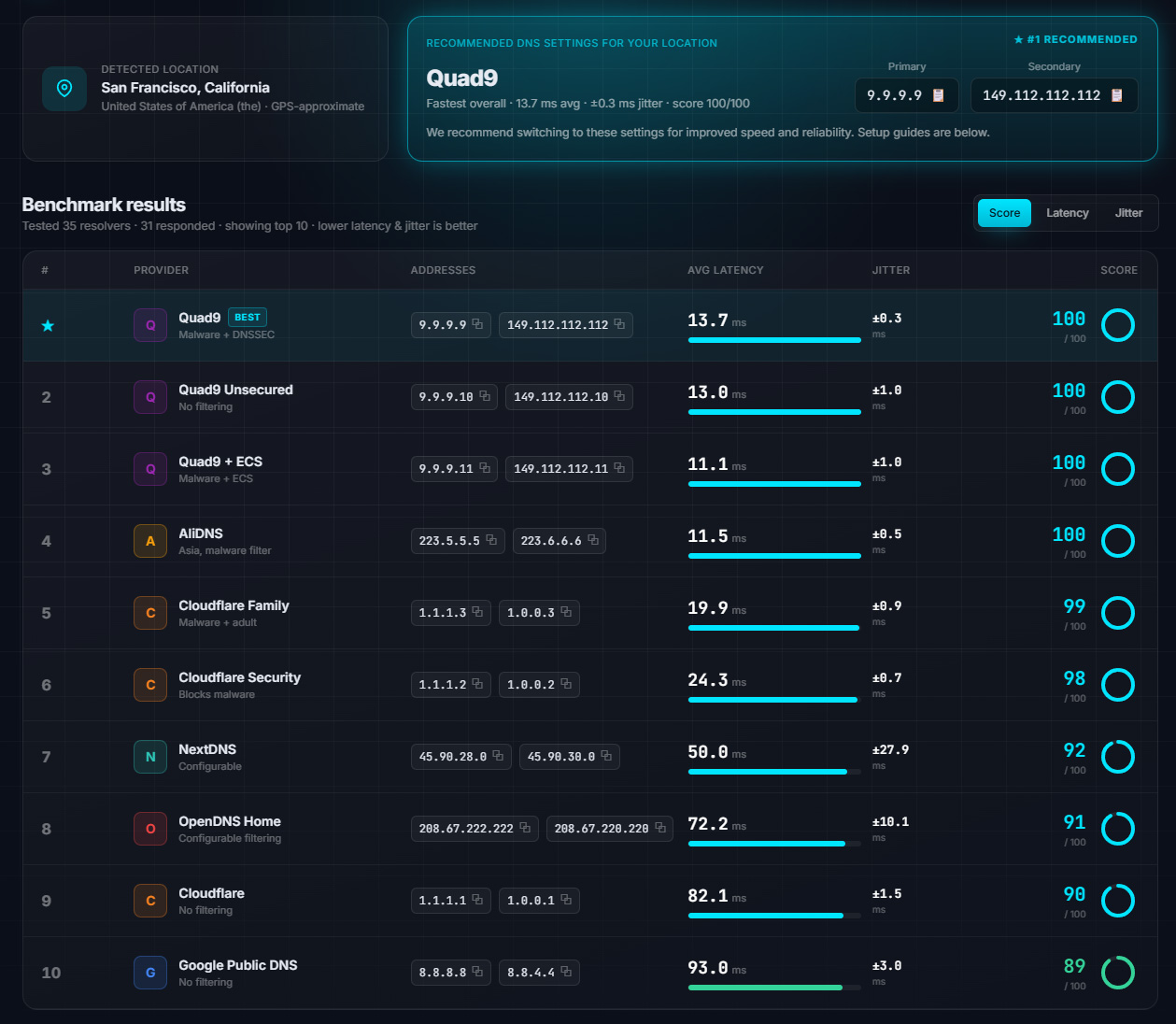
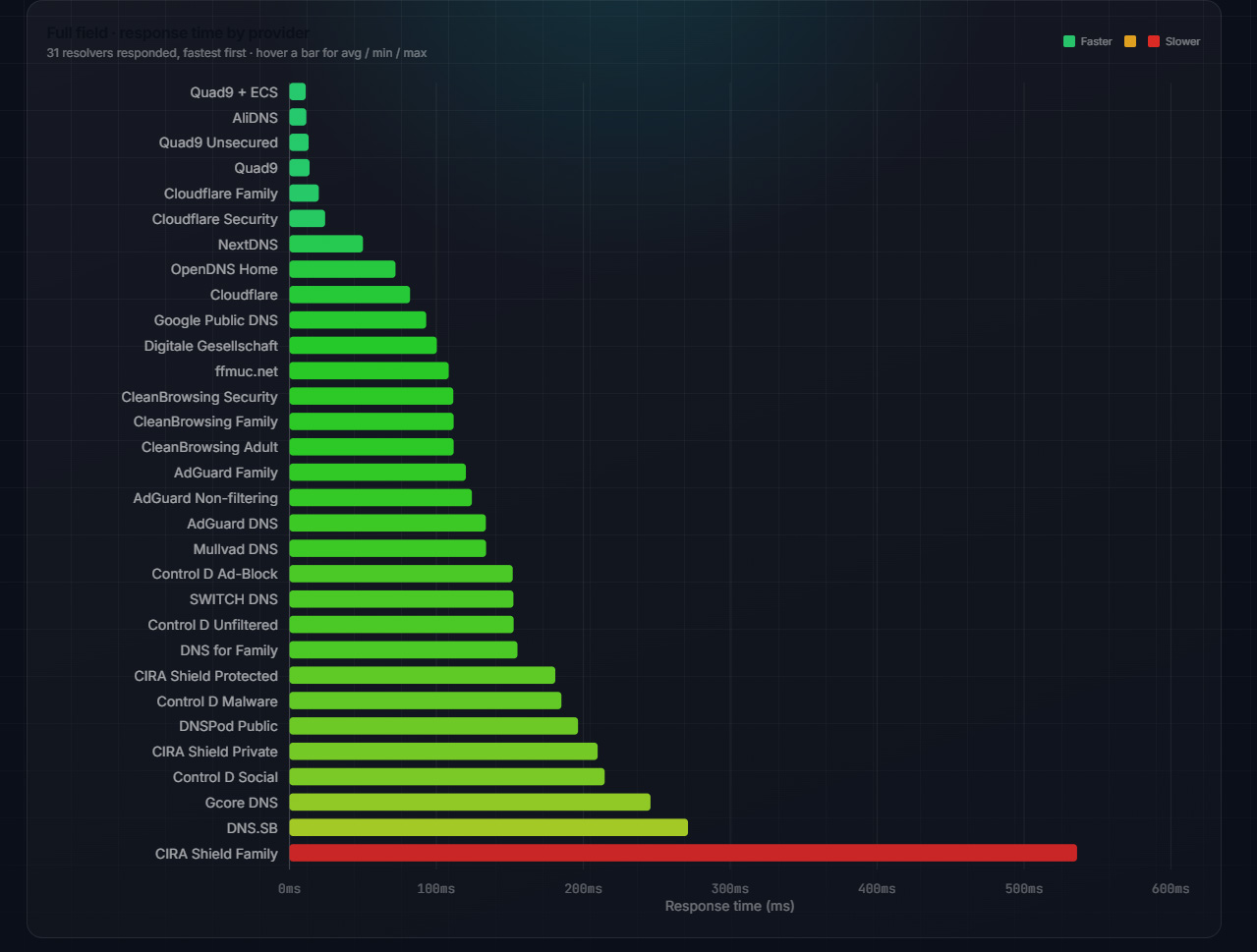
The second is availability. The remediation for this advisory involves rebooting appliances that, in a GSLB design, are part of your resolution path. If you do not know what normal looks like — per-resolver response times, failover behaviour, DNS server performance under load — you will not be able to tell a healthy failover from a broken one during the change window. Capturing that baseline before you patch takes about ten minutes with a free network diagnostic tool that measures real DNS resolution latency, and it is the reference you will want when someone asks whether the outage is DNS or the application.
The cloud security and patch checklist
Citrix is explicit that no workaround exists. In order:
- Preserve evidence before you patch. Capture logs, configuration snapshots, support bundles and any core dumps. Upgrading overwrites the forensic record you will need if this turns out to be an incident rather than a maintenance task.
- Upgrade to a fixed build. 14.1-73.37 or later, 13.1-64.23 or later, 14.1-73.37 FIPS, or 13.1-37.279 for FIPS and NDcPP. On 13.1, run
show ns variablefirst — Citrix warns of upgrade reboot loops otherwise. - Run the IOC scan, and do not trust a clean result. NetScaler Console 14.1-73.36 or later offers indicator scanning, but Citrix states plainly that the indicators do not cover every technique. A negative scan is not proof of a negative.
- Rotate everything the appliance could read. Session secrets, LDAP and service-account credentials, API keys, and TLS certificates and private keys terminated on the device.
- Hunt in DNS and proxy logs. Look for outbound resolution from appliance management IPs, unexpected lookups to newly registered or dynamic-DNS domains, and any appliance bypassing your enterprise resolvers for an external DNS over HTTPS endpoint.
- Take the management interface off the internet. The NSIP and management plane should never have been publicly reachable, and this is the week to prove they are not.
- Check GSLB and split-horizon records against a known-good configuration export, not against what the appliance currently reports about itself.
Industry impact
The uncomfortable part of this cybersecurity news cycle is not the CVSS score. It is the 48-hour window in which thousands of organisations knew something was being exploited, had no CVE, no patch and no workaround, and had to choose between leaving remote access running and switching it off. That choice — accept a probable compromise or impose a self-inflicted network outage — is now a recurring feature of edge-appliance operations rather than an exceptional event, and it is the second time this month a vendor has effectively asked customers to make it.
The strategic lesson is architectural. An appliance that terminates TLS, authenticates users, holds certificate private keys and answers DNS is four separate trust domains collapsed into one box on the public internet. That consolidation is why NetScaler is efficient, and it is also why a single input-validation bug becomes a full-perimeter event. Teams that have already pulled authentication into an identity provider, moved certificate private keys into an HSM or key manager, and kept GSLB separate from their remote-access path are having a materially easier week than teams that have not.
Everyone else should assume the next one is already being written. The durable defences are the boring ones: a current inventory of internet-facing appliances, management planes that were never exposed, credentials that can be rotated in hours rather than days, and enough DNS security telemetry that a strange lookup from a load balancer is something you notice rather than something you reconstruct afterwards.
Sources
- Citrix — Security Bulletin CTX697096 for CVE-2026-88771 through CVE-2026-88778
- CISA — Critical zero-day vulnerabilities exploited in Citrix NetScaler ADC and Gateway
- BleepingComputer — Citrix confirms two NetScaler RCE zero-days exploited in attacks
- BleepingComputer — CISA orders federal agencies to patch exploited Citrix flaws
- watchTowr — Citrix NetScaler zero-day vulnerabilities FAQ
- The Hacker News — Warning: two unpatched Citrix NetScaler RCE zero-days under active exploitation
- Tenable — Frequently asked questions about reported Citrix NetScaler zero-day vulnerabilities
Independent editorial analysis published by DNS Benchmark Pro / Genext Information Systems. The Citrix headquarters photograph is by Coolcaesar, licensed CC BY-SA 3.0 via Wikimedia Commons; the Citrix wordmark is the vendor's official logo, public domain, via Wikimedia Commons; the benchmark screenshots are original captures of the DNS Benchmark Pro engine. No images on this page are AI-generated.